One Framework, Many Requirements: How GRC Brings Your Compliance Together
Most growing businesses don't have a compliance problem. They have a compliance pile-up. GRC is how you turn that pile into one system.
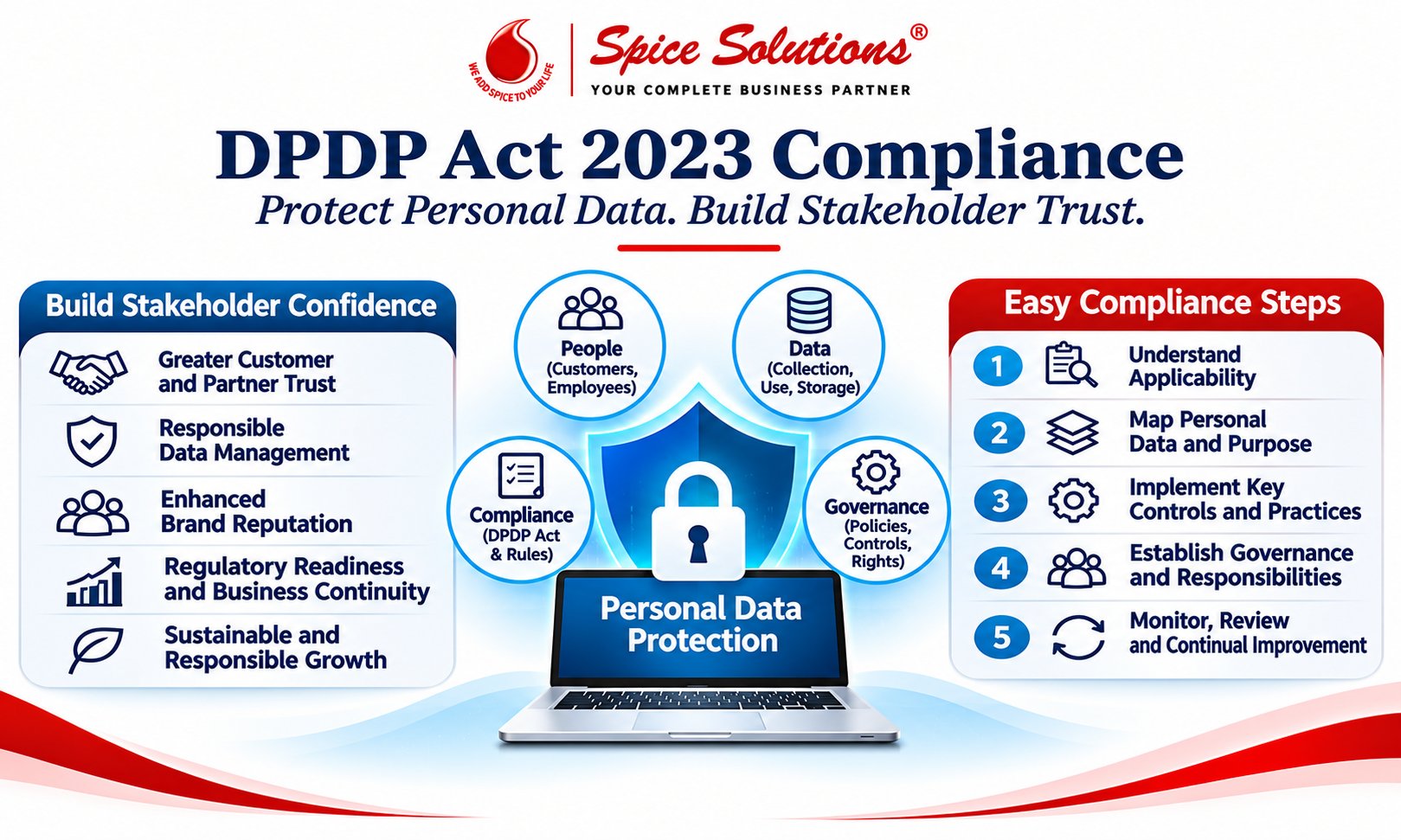
Picture a typical mid-sized company in Kerala today. It holds ISO 9001 for quality. A large customer has asked for ISO/IEC 27001 before renewing the contract. The factory needs ISO 45001 and ISO 14001 to bid for export work. And now India's Digital Personal Data Protection (DPDP) Act is moving from paper to practice, with its main obligations taking effect in phases through May 2027.
Each requirement arrives with its own consultant, its own manuals, its own audit calendar and its own spreadsheet of risks. Within a few years, the same managers are filling in four sets of forms that ask the same questions in slightly different words.
There is a better way. It is called GRC: Governance, Risk and Compliance.
What GRC really means
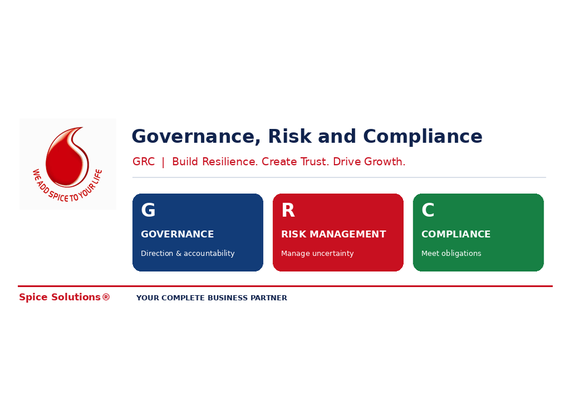
GRC is a single, joined-up way of running three things that most organisations manage separately.
Governance sets direction and accountability: who decides, what the policies are, and how leadership knows the business is on track.
Risk is how you spot what could go wrong (or right) and decide what to do about it, using one consistent method.
Compliance is meeting every obligation you have signed up to or are bound by: laws, regulations, contracts, customer requirements and ISO standards.
The key word is integrated. GRC is not another standard to certify against. It is the framework that lets all your existing requirements share one structure, one risk process and one set of controls.
Why compliance in silos stops working
When each requirement is handled on its own, the costs creep up quietly.
Duplicated effort. Separate document control, training records, internal audits and management reviews for each standard.
Conflicting answers. The quality team rates a supplier as low risk while the IT team flags the same supplier as a data-security risk. Nobody sees both.
Audit fatigue. Staff face three or four audits a year, each asking for evidence they have already produced.
Blind spots. New legal duties, such as data protection, fall between departments because no single register tracks them.
Leadership in the dark. Top management receives separate reports that never add up to one clear picture of risk.
The result is compliance that costs more and protects less.
How GRC brings the requirements together
Integration works because modern ISO management system standards were designed to fit together. They share ISO's Harmonized Structure: the same ten clauses, the same core terms and many identical requirements. ISO 9001:2026, the newest edition of the quality standard, follows this structure too. A GRC approach builds on that common backbone in four practical ways.
One obligations register. Every requirement the business must meet is listed once: ISO clauses, the DPDP Act, labour and environmental laws, factory and pollution-control rules, and customer contract terms. Each entry has an owner, a review date and evidence of compliance.
One risk methodology. Quality, information security, health and safety, environmental and data-privacy risks are assessed on the same scale in one risk register. Leadership can finally compare risks across the business and fund the ones that matter most.
One set of shared controls. A single control often satisfies several requirements. Access control, supplier evaluation, competence and training, document control and incident management are designed once and mapped to every standard and law they serve.
One assurance cycle. Combined internal audits, one management review and one corrective-action system replace parallel calendars. Certification bodies can also run integrated audits, which saves auditor days.
For organisations that want a reference model, ISO 37301 (compliance management), ISO 31000 (risk management) and ISO 37000 (governance of organisations) give recognised guidance for each part of GRC.
One control, many requirements: a worked example
Here is how a few shared controls serve several requirements at once in a company working to ISO 9001, ISO/IEC 27001, ISO 45001, ISO 14001 and the DPDP Act.
Shared control
Requirements it helps satisfy
Register of legal and other requirements
ISO 14001 and ISO 45001 compliance obligations, ISO/IEC 27001 legal and contractual requirements, DPDP Act duties
Supplier and vendor evaluation
ISO 9001 externally provided processes, ISO/IEC 27001 supplier security, ISO 45001 contractors, DPDP data-processor contracts
Incident and breach management
ISO/IEC 27001 security incidents, ISO 45001 incident investigation, ISO 14001 emergency preparedness, DPDP breach reporting
Access control and data security
ISO/IEC 27001 Annex A controls, DPDP reasonable security safeguards
Competence and awareness training
Clause 7 of every ISO management system standard
Document and record control
Clause 7.5 of every ISO standard, DPDP record and log retention
Internal audit and management review
Clauses 9.2 and 9.3 of every ISO standard, run once for all
Build each control once, map it to everything it covers, and audit it once. That is GRC in practice.
What businesses gain
Less paperwork. One manual, one set of procedures and one record system instead of four.
Lower audit cost and disruption. Combined internal audits and integrated certification audits reduce days lost to audits.
Better decisions. One risk register shows leadership the real top risks across quality, security, safety, environment and privacy.
Faster response to new rules. When a law like the DPDP Act arrives, it is added to an existing obligations register and mapped to existing controls, not built from scratch.
Stronger customer confidence. Large customers and overseas buyers increasingly ask for evidence of governance, not just certificates. An integrated GRC system lets you show it in one place.
Getting started: five practical steps
List what you already hold. Note every certification, legal licence and major customer requirement in force today.
Build the obligations register. Bring all requirements into one list with an owner and review date for each.
Merge the risk registers. Agree one risk scale and move quality, security, safety, environmental and privacy risks into one register.
Map controls to requirements. Identify shared controls and retire duplicate procedures and forms.
Run one assurance cycle. Combine internal audits and management reviews, and ask your certification body about integrated audits.
You don't need to start from zero. If you already hold ISO 9001 or ISO/IEC 27001, most of the structure is already in place.
How Spice Solutions can help
Since 2009, Spice Solutions has helped organisations in India and abroad design, implement and certify management systems across quality, information security, health and safety, environment, energy and AI. Our lead auditors work across standards, so we see where the requirements overlap and where they differ.
Our GRC services bring that experience together:
GRC readiness and gap assessment across your existing certifications and legal duties
Integrated management system design: one manual, one risk register, one obligations register
DPDP Act readiness built into your ISO/IEC 27001 ISMS
Combined internal audits and management reviews
Transition support for ISO 9001:2026 within an integrated system
Ready to turn your compliance pile-up into one working system? Contact us through spicesolutions.com or message us on WhatsApp to book a GRC readiness discussion.