
AI is already working inside your business. The question is whether anyone is managing it.
Your sales team drafts proposals with a chatbot. Your HR software screens CVs. Your developers use AI coding assistants, and your product may now include an AI feature of its own. Each of these brings real gains, and real risks: biased decisions, leaked confidential data, wrong answers given with confidence, and questions from customers you cannot yet answer.
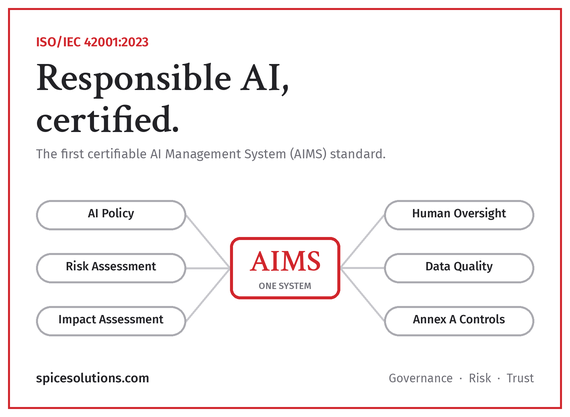
Most organisations adopted AI faster than they built rules for it. ISO/IEC 42001:2023, the world's first certifiable management system standard for artificial intelligence, closes that gap.
ISO/IEC 42001:2023 sets the requirements for an Artificial Intelligence Management System (AIMS). It was published in December 2023 by ISO and IEC, the same bodies behind ISO/IEC 27001 for information security.
It is a management system standard, not a technical test of your algorithms. It does not ask auditors to inspect source code or model weights. It asks whether your organisation has clear policies, defined roles, a working risk process and the right controls to develop, provide or use AI responsibly, and whether those keep improving over time.
In short, ISO/IEC 42001 does for AI what ISO 9001 did for quality and ISO/IEC 27001 did for information security.
The standard applies to any organisation, of any size or sector, that plays a role in AI. That includes:
If your clients are asking how you use AI, or your own team uses AI tools with customer data, ISO/IEC 42001 is relevant to you.
ISO/IEC 42001 follows ISO's Harmonized Structure, so its clauses on context, leadership, planning, support, operation, performance evaluation and improvement will feel familiar to anyone who already runs ISO 9001 or ISO/IEC 27001. The AI-specific heart of the standard covers:
Customers are asking. Enterprise buyers and overseas clients now add AI questions to vendor security reviews. A certificate answers them once, with independent assurance. Adoption is growing quickly: BSI alone awarded its 50th ISO/IEC 42001 certificate in October 2026, more than triple its 2025 total, with Asia Pacific, including India, leading the way.
Regulation is arriving. The EU AI Act is already in force. After the 2026 Digital Omnibus changes, its obligations for stand-alone high-risk AI systems apply from 2 December 2027, and for AI built into regulated products from 2 August 2028. Indian companies selling software or services into Europe will feel this. At home, MeitY's India AI Governance Guidelines (November 2025) favour voluntary commitments and self-regulation, which makes a recognised standard the natural way to show responsible AI.
It fits what you already have. Because ISO/IEC 42001 shares its structure with ISO/IEC 27001 and ISO 9001, it can be added to an existing management system rather than built from scratch. Shared policies, risk processes, internal audits and management reviews keep the extra effort modest.
For organisations already certified to ISO/IEC 27001, much of this groundwork already exists.
Since 2009, Spice Solutions has guided organisations in India and abroad to certification across quality, information security, health and safety, environment and energy. We now bring the same practical, people-first approach to AI governance.
Our ISO/IEC 42001 services include:
Ready to show your customers that your AI is in safe hands? Contact us through spicesolutions.com or message us on WhatsApp to book an ISO/IEC 42001 readiness discussion.